Computation for science
Numerical methods for PDEs in computational biophysics, and compartmental models of transmission and control.
Focus Areas
I develop and implement numerical methods for multidimensional partial differential equations: finite difference schemes, Matched Interface and Boundary (MIB) methods, and finite element methods, run on high-performance computing platforms. The applications are in drug design and protein engineering.
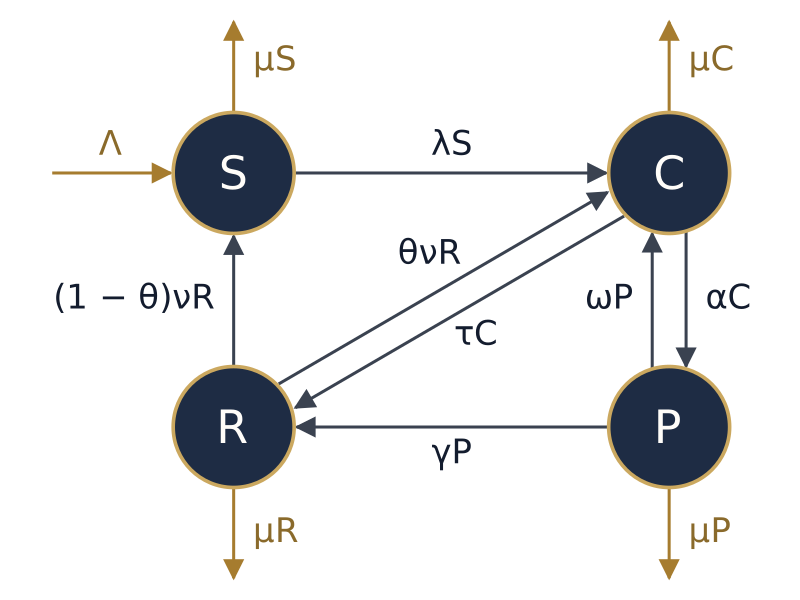
A separate part of my work uses compartmental dynamical systems, where the questions are about thresholds and control: what the reproduction number is, whether the endemic equilibrium is stable, and which intervention strategy is worth what it costs.
Current Projects
Biomolecular Solvation
Developing a Variational Implicit Solvation Model incorporating Size-Modified Poisson-Boltzmann (SMPB) theory, diffuse interface approaches, and ensemble averaged electrostatics for accurate free energy calculations in drug design and protein engineering.
High-Order Numerical Schemes
Developing robust solvers for interface problems and stiff systems, with focus on three-dimensional p-Laplace equations using finite difference methods, efficient ADI time-stepping for parabolic equations, and MIB methods for complex geometry in solvation models.
Related paper: Numerical solution to the three-dimensional p-Laplace equation (JCAM, 2026) →
Mathematical Epidemiology & Transmission Dynamics
I build and analyze nonlinear compartmental models of spread through a structured population. The analysis follows a familiar course: positivity and boundedness of solutions, the reproduction number from the next-generation matrix, then the disease-free and endemic equilibria and their local and global stability, usually by Lyapunov arguments. I also check for backward bifurcation, since where it occurs, pushing the reproduction number below one is no longer enough to eliminate the disease. Optimal control and cost-effectiveness analysis come last, to rank the candidate interventions.
Methods
Related work
Computational Tools
Selected Visualizations